Guides
Room for another electrical contractor: market and startup basics
Starting an electrical contracting business means sizing your market and crew capacity before you lease a van, price a panel upgrade, or hire an apprentice.
What to take away
- Most US metros have room for another electrical contractor that picks one lane: service calls, residential rough-in, or commercial build-out.
- Size demand by counting licensed contractors in your drive radius, then dividing area population by that count. Above about 3,000 residents per contractor, general service work is usually there to win.
- A one-van shop typically costs $28,000 to $60,000 to stand up, plus 30 to 60 days of operating cost as working capital.
- Break-even is committed monthly cost divided by contribution per billed hour. A solo operator often needs 25 to 30 billable hours a week.
- US owners answer to a state licensing board, the local AHJ, and the NEC. Canadian rules sit in their own block below.
Count the competition, not the optimism
Four steps size a market in an afternoon.
Count the competition
- Download the licensed contractor roster from your state board. Most publish one.
- Count the contractors within a 30-minute drive of your intended shop address.
- Divide the population of that area by the count.
- Repeat for the next town over and compare.
The ratio is your decision rule. At or below 1,500 residents per contractor, the pool is crowded and a generalist van fights for share.
Between 1,500 and 3,000, work exists if you hold a niche: EV chargers, panel upgrades, generator service. Above 3,000, plain service work is usually available.
That ratio is a planning heuristic, not a market study. Confirm it with two weeks of call volume from a dispatcher, or from a nearby competitor who does not serve your street.
Watch who already advertises. The list of electrical contractors worth watching shows how larger firms position themselves, which exposes the gap a small shop can hold.
For cost inputs, the BLS occupational page for electricians (SOC 47-2111) publishes current employment and wage figures by metro, refreshed each release. Use the latest one for a 2027 build.
What it costs to stand up
| Item | Typical range | Notes |
|---|---|---|
| State licence and exam fees | $200 to $800 | Renews; some states require a master on staff |
| General liability and bond | $2,000 to $6,000 a year | Rises with revenue and crew size |
| Used cargo van with shelving | $18,000 to $35,000 | New costs more |
| Hand, power, and test tools | $4,000 to $10,000 | Test gear drives the top of the range |
| Van stock: fittings, breakers, wire | $2,000 to $5,000 | Build-outs hold more inventory |
| Software, phone, dispatch | $100 to $300 a month | Per user, not per van |
| Working capital | 30 to 60 days of costs | Customers pay after the job |
Those are typical ranges for a one-van US shop and shift with your state. The starter equipment list for new owners splits the tool package into first-week and first-year buys, which keeps the opening order honest.
Example: the rate that covers break-even
- Add committed monthly costvan $700, insurance $500, software $150, storage $400, owner draw $5,000. Total $6,750.
- Set loaded laboura $45 hourly journeyperson plus 30 percent burden is about $58.50 an hour.
- Pick billable hours you can actually sell100 a month for one electrician.
- Required rate = ($6,750 / 100) + $58.50 = $126 an hour.
Round the rate to $130. Contribution per billed hour is then $71.50 after direct labour, and break-even sits near 95 billed hours a month, about 22 a week.
That leaves roughly a week a month for quoting, permits, supply runs, and warranty callbacks. Miss the hours and the van payment still lands. Overhead is deductible, and IRS Publication 535 explains which costs qualify.
The guide to margins and break-even runs the same math for a two-van shop, where every added truck moves the hour target.
Crew capacity in month one
One licensed electrician plus one apprentice covers a residential service van. Expect four to six simple calls a day, or one or two panel replacements.
[figure 1]
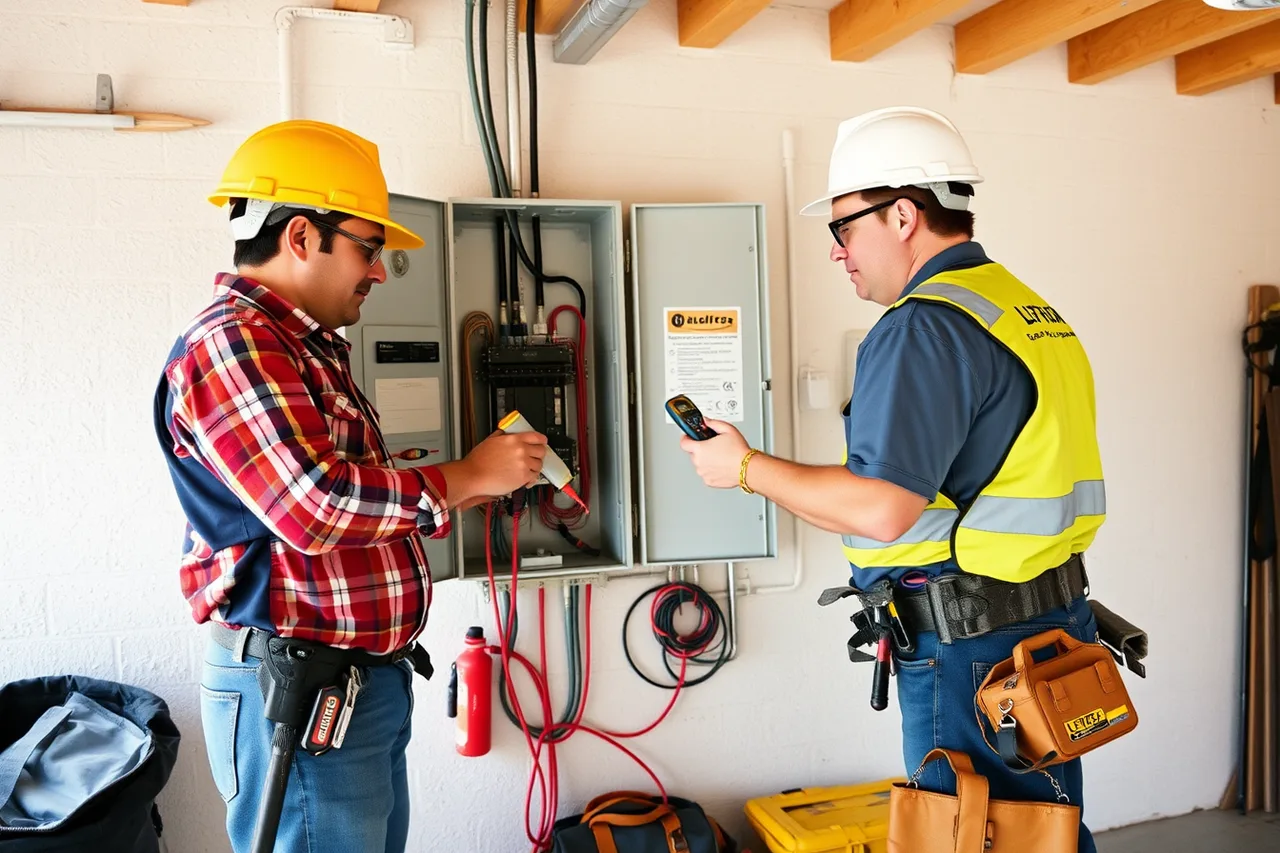
The same pair can rough in a house up to roughly 3,000 square feet. It cannot carry a 40,000 square foot tenant improvement, which needs a foreman, three to five electricians, and someone handling submittals.
On commercial work, hold journeyperson to apprentice at 1:1 for terminations and 1:2 for rough-in. Higher apprentice ratios look cheap on the bid and costly at inspection.
Hire the apprentice in month one, not a second journeyperson. Add office help when quoting eats your evenings.
Licensing and permits: US first
States split licensing between the business and the qualifying individual. Some require both. Start at your state board, then confirm with the AHJ that issues permits in each town you work in.
The NEC is the base code most US jurisdictions adopt, with local amendments and staggered editions. Check the current edition on the NFPA 70 National Electrical Code page before you buy material for a job.
The license requirements walkthrough lists what to ask your board about qualifying individuals, insurance minimums, and reciprocity, which saves a wasted application fee.
Safety obligations follow NFPA 70E for arc flash and PPE. OSHA rules drive training and lockout procedures, and those training hours belong in your cost build. Carry workers' compensation from the first employee.
This article covers business decisions only. Confirm permit, inspection, and energization rules with your AHJ and a licensed electrician.
Canada: the secondary block
Canadian owners run a different paper trail. Ontario permits and inspection go through the Electrical Safety Authority, BC through Technical Safety BC, and contractor licensing in Alberta through Municipal Affairs. Quebec routes trade certification through the CCQ.
The Canadian Electrical Code applies with provincial amendments, such as Ontario Regulation 164/12. Payroll, GST/HST, and construction holdback follow CRA and provincial rules. Red Seal certification travels between provinces; contractor licensing does not.
Cold weather belongs in the estimate. Cable that bends at 20 Celsius turns stiff at minus 20, and the hours climb with it.