Guides
The starter equipment list for an electrical contractor business
A starter kit for an electrical contractor is a van, a meter, benders, ladders, power tools, and test gear sized to the work you actually sell.
What to take away
This starter equipment list for an electrical contractor covers what to buy first, what to rent, and the lockout hardware an energy-control procedure requires. Prices are typical 2026 street prices and move with the supply house.
- The first purchase is a true-RMS multimeter (Fluke 117) and a non-contact voltage tester (Klein Tools NCVT-3P); every other tool follows the work you have sold.
- Buy a bender for the conduit you actually run. An EMT hand bender, a rigid/IMC bender, and a hydraulic knockout set cover most service and fit-up work.
- Ladders and step stools carry duty ratings (Type IA, 1A, I, II, III). Match the rating to the heaviest person plus tools.
- Cordless drills, an SDS rotary hammer, a band saw, and a fish tape do the daily work. Rent a trencher or a lift until the volume justifies owning one.
- Insulated hand tools and arc-rated PPE are sized to the incident energy at the task, which comes from a study, not from a catalog page.
This article covers business and purchasing decisions only. It does not give work methods, PPE selection, or energy-control procedure. Those come from CSA Z462, OSHA 1910 Subpart S and 1910.147, the manufacturer's instructions, and the authority having jurisdiction.
The core kit, by name
Test and measurement. Start with a true-RMS digital multimeter rated CAT III or CAT IV for the voltage class you work on. The Fluke 117 lists around $220 in a CAT III 600V rating, and the Fluke 87V adds CAT IV 600V and a 1000V range for about $400.
Klein Tools sells the NCVT-3P non-contact tester for about $40, and it takes the first check before anything else. A clamp meter handles load readings on service and panel work: the Klein CL800 is about $120, and the Fluke 376 FC is about $420 and logs readings to a phone.
For finish calls, add a receptacle tester and a ground-fault circuit interrupter tester: the Klein RT210 at about $25 and the Klein RT250 at about $35. An insulation resistance tester (megohmmeter) covers motor and feeder work. The Fluke 1587 FC and the Megger MIT230 both land in the $700 to $900 range.
Conduit and cable. Bend the conduit you run. The Klein Tools 56206 is a 3/4-inch EMT hand bender at about $70, and the Greenlee 841 covers the same trade size for about $100. For rigid and IMC, the Greenlee 843 in 3/4-inch runs about $180.
A hydraulic knockout set for panel and enclosure penetrations costs more than any single item here. The Milwaukee 2677-20 M18 kit is typically $1,000 to $1,200, and the Greenlee 7310 is $1,200 to $1,400.
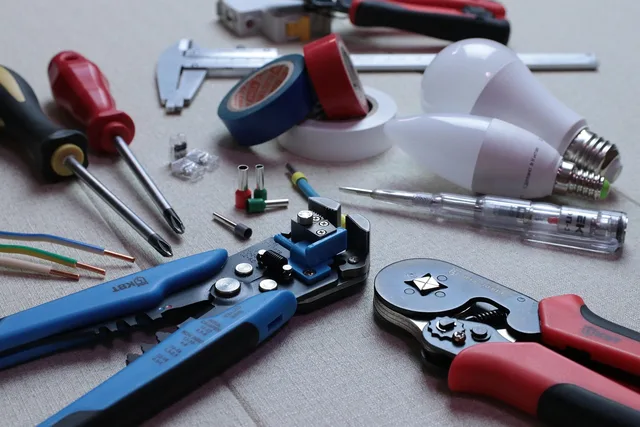
Cutting and pulling: the Klein 63050 cable cutter (about $40), the Klein 11055 stripper for 8 to 18 AWG (about $30), a 100-foot steel fish tape such as the Klein 56334 (about $60), and a set of pulling grips.
Use a lubricant rated for the jacket you pull. Ideal Yellow 77 sells for about $20 a quart, and Klein and Greenlee sell equivalents.
Access and handling. Fiberglass, not aluminum, on anything you stand on. A 6-foot Type IA step ladder such as the Werner NXT1A06 is about $150 and carries a 300-pound duty rating.
An extension ladder: the Werner D6200-2, 28 feet, Type IA, about $400. A platform ladder such as the Werner P6200 in 6 feet is about $200 and adds a work tray.
A convertible hand truck runs $150 to $250 and moves panels and gear. A wire caddy such as the Rack-A-Tiers Wire Dispenser keeps a pull from turning into a two-person wrestling match.
Power tools. An 18V or 20V cordless drill and impact driver. The Milwaukee M18 Fuel 2904-20 hammer drill is about $230 bare, and the DeWalt DCD800 is about $180. Impact drivers run $150 to $200 bare.
For anchors and masonry, an SDS rotary hammer: the Bosch Bulldog GBH18V-26 is about $300 bare, and the Milwaukee 2715-22 kit is about $500.
A band saw cuts conduit and strut, and the Milwaukee M18 Fuel 2729-20 deep-cut is about $400. A reciprocating saw such as the Milwaukee 2821-20 is about $200.
A jobsite vacuum, the Milwaukee 0970-20 or the DeWalt DWV010, runs $200 to $300 and saves the dust bill the finish trade will hand you.
Hand tools. Insulated screwdrivers, pliers, and cutters rated for the voltage class. Sets from Klein Tools and Wiha run $40 to $90, and 1000V insulated pliers from Knipex or Klein run $50 to $80 a pair.
Add a torpedo level (about $25), a Stabila magnetic level (about $60), a chalk line, and a tape. A nut driver set, a hex key set, and a torque wrench such as a CDI or Snap-on (about $150 to $300) cover terminations that specify a value.
Consumables. Wire nuts (Ideal Wire-Nut or 3M Scotchlok), connectors, couplings, and straps. Staples, 3M Scotch 33+ tape, markers, and a stocked fastener assortment. These are the line items that send a van back to the supply house at 3 p.m.
Rent, subcontract, or buy
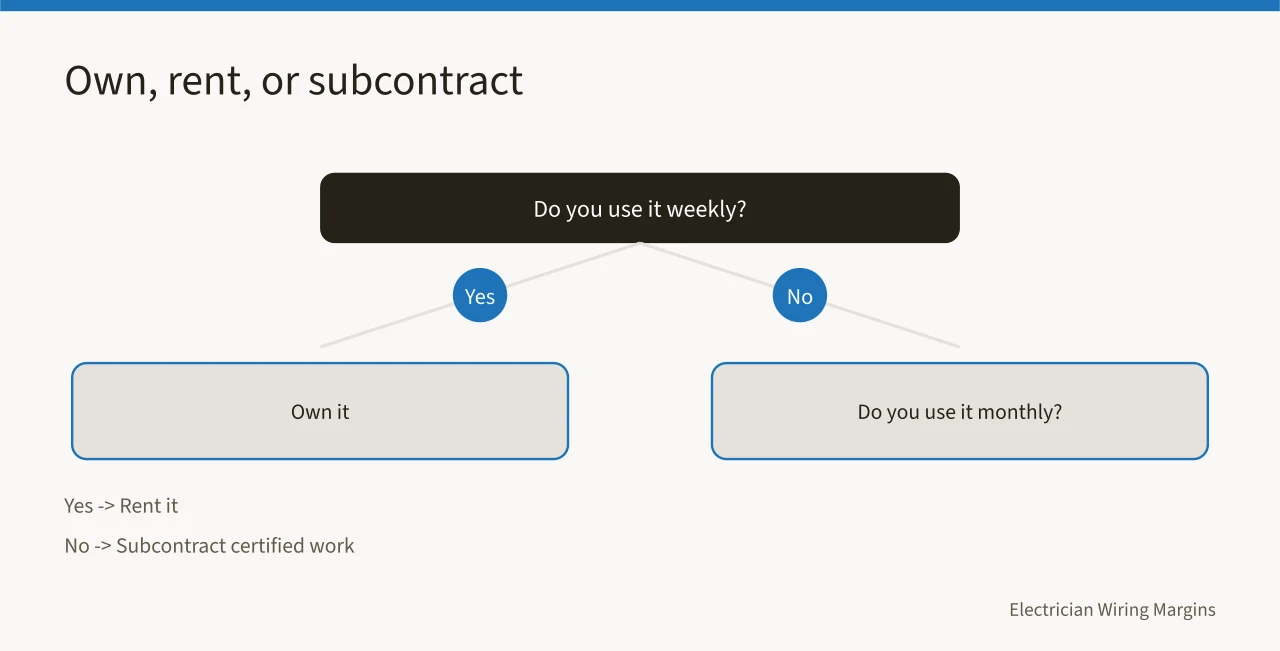
Own what you use weekly. Rent what you use monthly. Subcontract what needs a certification you do not hold.
Own vs rent triggers
Item
- Trencher
- Feeders most weeks
- Lift
- Ceiling maintenance contract
- Knockout set
- Panel changes routine
- Thermal camera
- You sell PM
- Cable puller
- Long pulls a service line
- Lockout hardware
- Day one, per 1910.147
Own when
- Trencher
- One upgrade a quarter
- Lift
- Single fit-out
- Knockout set
- One a year
- Thermal camera
- One scan for report
- Cable puller
- One-off 400A run
- Lockout hardware
- Never
Rent when
- Trencher
- Lift
- Knockout set
- Thermal camera
- Cable puller
- Lockout hardware
Own when
- Trencher (Ditch Witch, Vermeer)
- You bury feeders most weeks
- Scissor or boom lift (Genie GS-1930, JLG)
- You hold a maintenance contract with ceiling work
- Hydraulic knockout set (Greenlee 7310, Milwaukee 2677-20)
- Panel changes are routine
- Thermal camera (Fluke TiS60+, FLIR E8)
- You sell preventive maintenance
- Cable puller (Greenlee 555, Southwire)
- Long feeder pulls are a service line
- Lockout hardware (Master Lock 410RED padlock, lockout hasp, Brady tags)
- Day one, per 1910.147
Rent when
- Trencher (Ditch Witch, Vermeer)
- One service upgrade a quarter
- Scissor or boom lift (Genie GS-1930, JLG)
- A single warehouse fit-out
- Hydraulic knockout set (Greenlee 7310, Milwaukee 2677-20)
- You do one a year
- Thermal camera (Fluke TiS60+, FLIR E8)
- You need one scan for a report
- Cable puller (Greenlee 555, Southwire)
- A one-off 400A run
- Lockout hardware (Master Lock 410RED padlock, lockout hasp, Brady tags)
- Never
A trencher, a lift, and a puller each carry transport, storage, and maintenance costs that do not show up on the invoice. The rental desk absorbs those on low-volume work.
Rental rates in most markets run $150 to $300 a day for a scissor lift and $200 to $400 a day for a walk-behind trencher, plus delivery and fuel.
What the rules require you to carry
OSHA's electrical contractors page names the hazards of this trade. It links the standards that apply. The hazards are:
OSHA lockout/tagout hardware
- Locks
- Tags
- Hasps
- Means to verify isolation
- shock
- electrocution
- musculoskeletal injury
- slips
- falls
- vehicle incidents
Read it before you build the PPE line in your budget.
The lockout/tagout standard, OSHA 1910.147, requires covered employers to have energy-control procedures. Employers must also have the hardware to execute them:
- locks
- tags
- hasps
- a means to verify isolation
That hardware is equipment, and it belongs on the list. Master Lock 410RED safety padlocks run about $25, and a lockout hasp and Brady tags complete the kit.
If you are still deciding what to buy first, reviewing electrical contractor equipment: strengths, gaps and a verdict walks through the trade-offs item by item.
OSHA's safety management guidance is the argument for buying the right gear once instead of replacing a cheap version every season. A program that finds hazards early spends less on both injuries and rework.
Arc-rated clothing, gloves, and face protection are selected from the incident energy at the task, which comes from an arc flash study or the tables in CSA Z462. Nobody picks that from a catalog.
Salisbury Class 00 rubber insulating gloves, rated 500V AC, sell for $70 to $120 a pair and need leather protectors over them. OSHA's electrical contractor resources link the standards; a licensed electrician and the AHJ settle what applies on your site.
Common questions
What does a new electrical contractor need on day one?
A true-RMS multimeter, a non-contact voltage tester, insulated hand tools, and a bender for the conduit you run. A step ladder and an extension ladder, a cordless drill and impact driver, and a stocked consumables bin. Add the lockout hardware your energy-control procedure calls for.
How much should the first kit cost?
Write it as a line in your startup budget rather than a target. The full kit named above, at 2026 street prices, typically lands between $3,500 and $6,000 before PPE, calibration, and the van. A stripped-down version without the knockout set is roughly $2,000 to $2,500.
Price each item at your supply house, add the calibration and PPE lines, and compare the total to your first month of booked work. If the kit costs more than a month of revenue, rent the specialty items.
When should I buy instead of rent?
Buy when the rental fee over a year exceeds the purchase price plus storage, maintenance, and the downtime of not having it on the truck. Rent when the tool sits idle for weeks between jobs.
Do I need arc-rated PPE to start?
The PPE you need depends on the incident energy at the task, and that comes from a study or from CSA Z462, not from a starter list. A licensed electrician and the authority having jurisdiction confirm what applies to the work you take.